
Smith & Wesson revolver frames

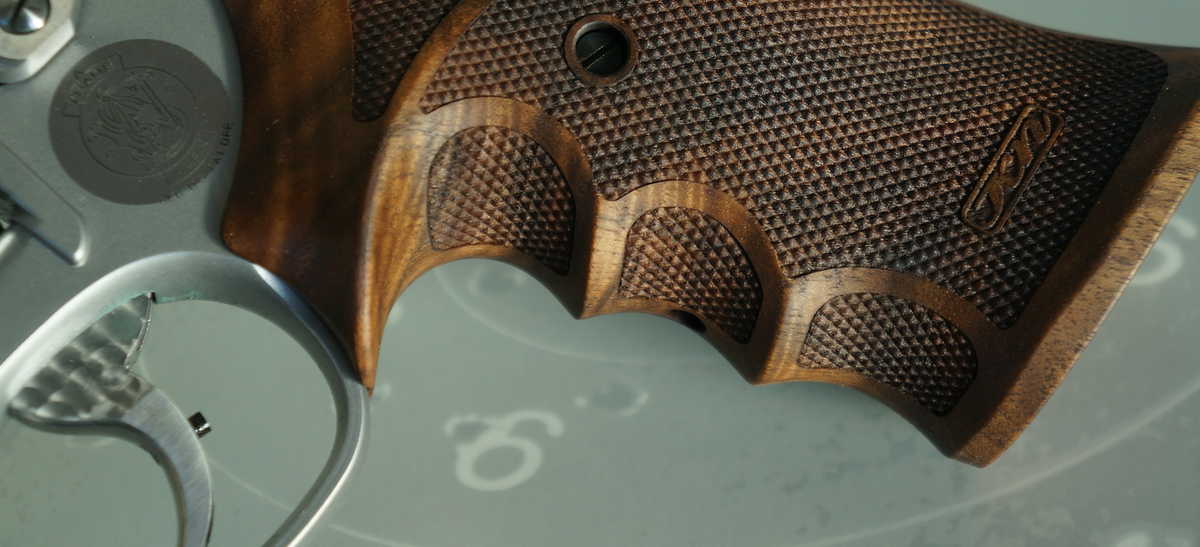
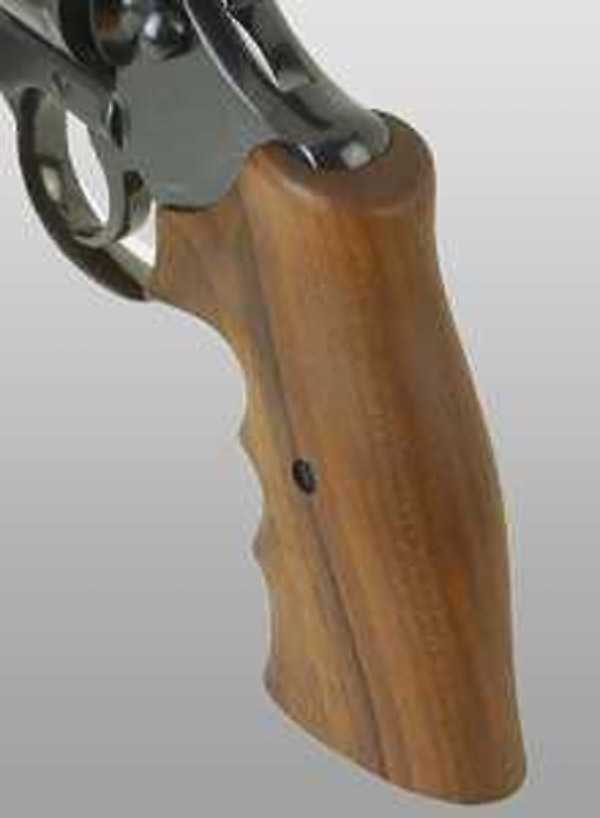
In the long history of the Smith & Wesson company different frames were developed. 
In order to differ the different frames we have arranged an overview to support you with the klnowledge you will need to find out which frame type you have.


J-Rahmen round butt neu

Smith & Wesson J-Frame Round Butt
--New Version--

Smith & Wesson integrated the firing pin with the frame for a number of reasons, and this called for a modification of the frame contour in the new J Frame. The most distinctive differences are the features marked by the red circles. Because of the difference in the dimensions we offer two grips with open backstrap to avoid either the frame standing proud or the grip from overlapping

J-Rahmen round butt alt

Smith & Wesson J-Frame Round Butt
--Old Version--

The J-Frame has been built by S&W for decades. The older edition is somewhat finer in the area where the thumb and trigger finger encloses the grip. Grips with an open backstrap are contoured according to the model, old or new. You may observe the distinguishing features marked in the red circles.

J-Rahmen square butt

Smith & Wesson J-Rahmen Square Butt

This frame is not very common and production was stopped in 1995. Without being able to make a comparison, it is difficult to see the difference to the Round Butt versions. Please compare the picture on the right with those above.

K-/L-Rahmen round butt

Smith & Wesson L-Frame Round Butt

For many years only short barreled revolvers were produced with Round Butt frames. Since 1995 this has changed and all revolvers are manufactured in the Round Butt configuration. The two essential features in defining the frame (L) are the cylinder size, about 39.5 mm, and the gage, between 4.5 and 5.0 mm at the location marked by the arrows. The Round Butt with it's slender form offers many possibilities in grip design. In the area where the grips are mounted, the K and L frames are identical. K/L (drum size 36.5 mm)

K-/L-Rahmen square butt

Smith & Wesson L-Frame Square Butt

Until 1995 this frame was produced for revolvers with barrel lengths over 4´´. The diameter of the cylinder(about 39.5 mm)and the thickness (gage 4.5-5.0 mm) of the area marked by the arrows are the factors to note in determining this frame type (L). Compared to the Round Butt version, the Square Butt is markedly heavier at the base of the frame. This limits the scope of the grip design for this frame. In the area where the grips are mounted, the K and L frames are identical. K/L (drum size 36.5 mm)

N-Rahmen square butt

Smith & Wesson N-Frame Square Butt

Until 2003, this was the biggest S&W frame available. In production up until 1995 this broad based Square Butt form was used for the models 27/28/29/629 as well as for a number of special editions. The two most important determining factors in recognising this frame as a N-frame type are the cylinder size (about 43.2 mm) and the broad gage (6.5-7.0 mm) in the area marked by arrows. The heavier frame base area somewhat reduces the design possibilities for grips. Nonetheless, we can offer a number of handsome, ergonomically refined models

N- frame round butt

Smith & Wesson N-Frame Round Butt

Since 1995 the design of the N-frame changed from a square to a round butt one.
Mostly found in .44 Magnum calibers the N-frame round butt was also used in the Model 627 in .357 Magnum as well as in the Model 610 in 10mm Auto. The two most important determining factors in recognising this frame as a N-frame type are the cylinder size (about 43.2 mm) and the broad gage (6.5-7.0 mm) in the area marked by arrows.
If you compare the N-frames you will see the square and round butt shape at the buttom of the frames.

X-frame round butt

Smith & Wesson X-Frame Round Butt

In 2003 Smith & Wesson presented the X-frame series.
Build for the .500 S&W Magnum ammunition first and later also the plattform for the .460 S&W Magnum catridge this frame is the latest frame Smith & Wesson is offering .